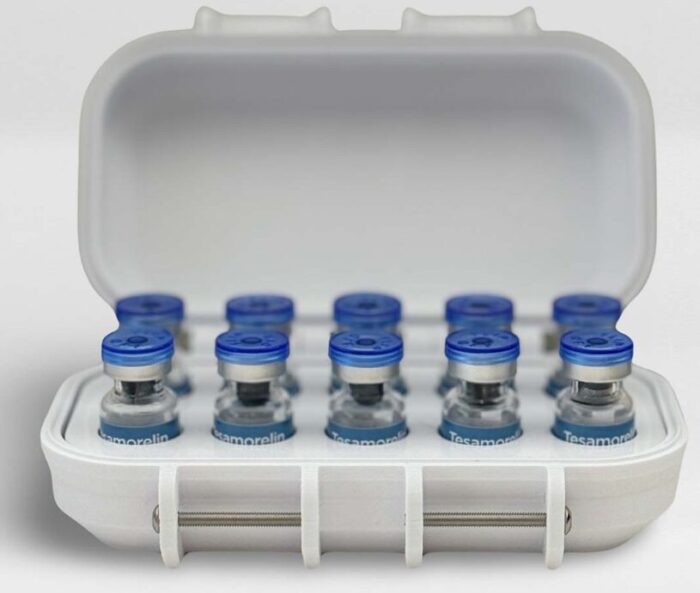
The question “Is it safe to combine Tesamorelin with CJC/Ipamorelin?” frequently arises in peptide research circles. In laboratory and preclinical settings, investigators study this combination because all three peptides act on the growth hormone (GH) axis, yet they do so through different molecular pathways. Understanding these mechanisms is essential before drawing any conclusions about safety, interaction, or experimental utility.
How CJC-1295 and Ipamorelin Work
CJC-1295 is a growth hormone-releasing hormone (GHRH) analog. It binds to GHRH receptors in the pituitary gland, stimulating the release of endogenous growth hormone in a pulsatile manner. Ipamorelin, on the other hand, is a growth hormone secretagogue (GHS) that mimics the action of ghrelin by binding to the GHS-R1a receptor. Together, CJC-1295 and Ipamorelin are often studied as a complementary pair because one increases GH pulse amplitude while the other increases pulse frequency.
In preclinical models, this dual-mechanism approach has been used to explore effects on muscle protein synthesis, tissue regeneration, lipid metabolism, and IGF-1 signaling. Researchers appreciate this combination because it tends to elevate GH levels more physiologically than synthetic growth hormone, potentially reducing negative feedback suppression.
How Tesamorelin Works
Tesamorelin is also a GHRH analog, but it is structurally modified to improve stability and biological activity. It has been studied primarily for its ability to reduce visceral adipose tissue while increasing IGF-1 levels through enhanced GH secretion. Unlike secretagogues such as Ipamorelin, Tesamorelin acts directly on the GHRH receptor, making its mechanism more similar to CJC-1295.
Because Tesamorelin already stimulates GH release via the GHRH pathway, combining it with CJC-1295 introduces potential redundancy. However, adding Ipamorelin may still offer additional secretagogue activity through a different receptor system, which is why researchers consider this triple combination in experimental contexts.
Potential Interactions and Overlap
The primary safety consideration when combining Tesamorelin with CJC/Ipamorelin is pathway overlap. Both Tesamorelin and CJC-1295 act on the same GHRH receptor, which means their effects may not be additive in a linear way. Instead, they could compete for receptor binding or create a ceiling effect in GH release.
Ipamorelin, however, works through a separate ghrelin receptor pathway, which suggests that its inclusion could still meaningfully influence GH pulse dynamics. In laboratory studies, this has led to hypotheses that Tesamorelin + Ipamorelin may be more rational than Tesamorelin + CJC-1295, though definitive comparative data remains limited.
Research-Based Safety Considerations
From a research perspective, safety is evaluated through controlled observation of biomarkers such as GH pulsatility, IGF-1 levels, glucose metabolism, lipid profiles, and inflammatory markers. When multiple GH-stimulating peptides are combined, investigators must carefully monitor for exaggerated endocrine responses, receptor desensitization, or metabolic stress.
- Possible elevated GH levels beyond physiological norms
- Changes in insulin sensitivity or glucose handling
- Alterations in lipid metabolism
- Potential receptor downregulation with chronic exposure
- Variability depending on dosage and timing
Laboratory Handling and Quality Control
If this combination is being studied in a laboratory setting, strict handling protocols are critical. Researchers should source peptides from reputable suppliers who provide Certificates of Analysis (COA), purity testing, and batch traceability. Lyophilized peptides should be stored at recommended temperatures, typically in a freezer, and reconstituted with sterile bacteriostatic water or saline immediately prior to use.
Minimizing freeze-thaw cycles, using sterile techniques, and maintaining accurate dosing records are all essential to ensure experimental reliability. Cross-contamination or peptide degradation could compromise results and lead to misleading conclusions about safety or efficacy.
Experimental Design Considerations
Researchers exploring Tesamorelin with CJC/Ipamorelin should consider testing each peptide alone before combining them. This allows for baseline comparison of GH and IGF-1 responses. Subsequent combination trials can then be structured to assess whether interactions are synergistic, neutral, or redundant.
Timing of administration is another key variable. Some studies separate GHRH analogs and secretagogues by several hours to mimic natural circadian GH patterns, while others administer them together to evaluate peak responses. The chosen protocol can significantly influence outcomes.
Conclusion
In controlled research environments, combining Tesamorelin with CJC/Ipamorelin is an active area of investigation rather than a settled question of “safe or unsafe.” Mechanistically, Tesamorelin and CJC-1295 overlap significantly, while Ipamorelin offers a distinct pathway that may complement either. Ultimately, safety and utility depend on experimental design, dosage, peptide purity, and careful biomarker monitoring.
For laboratories studying the GH axis, this combination provides a valuable model for understanding peptide interactions, receptor dynamics, and metabolic outcomes. However, rigorous methodology and high-quality reagents remain essential for producing meaningful and reproducible data.