KPV Peptide is a topic in laboratory and preclinical research. This guide explains the scientific context, how to assess the evidence, and which quality controls matter when U.S. laboratories evaluate research materials. It is educational content for qualified research settings—not dosing, treatment, or personal-use guidance. Laboratories comparing materials can review the research peptide catalog and the site’s laboratory quality standards before approving a study purchase.
Research context and terminology
This subject should be evaluated by separating molecular mechanism, experimental model, measured endpoint, and evidence quality. That framework prevents preliminary findings from being presented as established conclusions.
KPV peptide (Lysine–Proline–Valine) is a short bioactive tripeptide fragment derived from the larger alpha-melanocyte-stimulating hormone (α-MSH). In biomedical research, KPV has attracted attention due to its potent anti-inflammatory properties and its ability to modulate immune responses without broadly suppressing immune function. Because of its small size and specific biological activity, KPV is considered a valuable model compound for studying inflammation regulation, epithelial integrity, and immune signaling pathways.
KPV is a naturally occurring peptide fragment that retains many of the anti-inflammatory effects of α-MSH while lacking its pigmentation-related activity. This separation of functions makes KPV particularly interesting to researchers who want to study inflammation modulation without influencing melanocortin pathways related to skin pigmentation.
Structurally, KPV consists of only three amino acids—lysine, proline, and valine—which gives it unique stability and signaling properties compared to longer peptides. Despite its simplicity, it interacts with multiple cellular pathways involved in immune regulation, oxidative stress, and tissue protection.
KPV is derived from the C-terminal region of α-MSH, a peptide that plays a role in inflammation control, appetite regulation, and pigmentation. Researchers discovered that even after removing the rest of the α-MSH molecule, the KPV fragment retained significant anti-inflammatory activity, suggesting that this short sequence contains a core functional motif.
This finding led to extensive investigation into KPV as an independent bioactive peptide, particularly in models of inflammatory disease, tissue injury, and immune dysfunction. Its minimal structure also makes it easier to synthesize, purify, and modify for experimental purposes.
KPV primarily exerts its effects through modulation of inflammatory signaling pathways. It has been associated with reduced expression of pro-inflammatory cytokines such as TNF-α, IL-6, and IL-1β, while supporting anti-inflammatory mediators. This balanced approach helps regulate immune responses rather than completely shutting them down.
Additionally, KPV has been linked to activation of intracellular signaling cascades that promote cellular resilience, antioxidant defense, and epithelial barrier integrity. These effects make it particularly relevant in studies of gut inflammation, skin irritation, and systemic inflammatory responses.
In immunological research, KPV is often studied for its ability to influence macrophage activity, T-cell responses, and neutrophil behavior. Unlike traditional anti-inflammatory drugs that may suppress immune function broadly, KPV appears to fine-tune immune activity, helping to restore balance rather than induce immunosuppression.
This regulatory effect makes KPV a compelling compound for studying chronic inflammation, autoimmune conditions, and immune-mediated tissue damage in controlled laboratory settings.
Inflammation and immune modulation studies
Gastrointestinal barrier integrity research
Skin inflammation and wound healing models
Oxidative stress and cellular protection experiments
Neuroinflammation and immune-brain interaction research
In gastrointestinal research, KPV has been investigated for its ability to support epithelial barrier function and reduce inflammatory damage in the gut lining. This makes it particularly relevant in studies exploring inflammatory bowel conditions and intestinal permeability.
Delivery, Stability, and Bioavailability
Like many peptides, KPV is susceptible to enzymatic degradation in biological environments, particularly in the digestive system. This presents challenges for oral delivery, which is why researchers often explore alternative administration methods or protective formulation strategies.
Encapsulation technologies, modified peptide analogs, and specialized delivery systems have been studied to enhance KPV stability and absorption. Storage conditions are also critical—KPV is typically kept in lyophilized form at low temperatures to maintain structural integrity.
Relevant research materials
- KPV Liquid Spray — review the listing for identity, format, and available batch documentation.
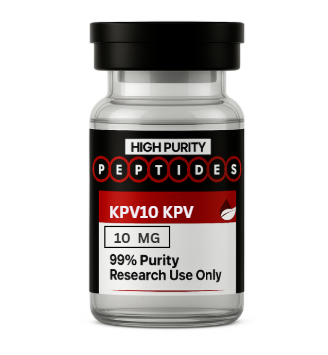
- KPV10 KPV 10mg × 10 vials — review the listing for identity, format, and available batch documentation.
- KPV5 KPV 5mg × 10 vials — review the listing for identity, format, and available batch documentation.
How to evaluate research quality
A defensible KPV Peptide evaluation begins with identity. The listing, material name, salt or counter-ion where relevant, quantity, lot number, and analytical record should agree. High-performance liquid chromatography can describe relative purity, while mass spectrometry can support identity by comparing observed and expected mass. Neither result alone proves biological activity, sterility, or fitness for this project’s protocol.
Study design and evidence limits
For KPV Peptide experiments, define the hypothesis and primary endpoint before selecting a material. Preserve the model, controls, assay validation, acceptance criteria, and statistical plan. A pilot can justify a larger experiment, but it is not confirmation. In-vitro, animal, and controlled human research answer different questions, so results should not be transferred between evidence levels without justification.
Continue researching this topic
- AHK-Cu Peptide related research overview
- SLUPP Peptide comparison and evidence guide
- Tesamorelin vs Sermorelin laboratory quality discussion
Frequently asked questions
What should a laboratory verify before studying KPV Peptide?
For KPV Peptide, confirm identity, lot-specific analytical documentation, labeling, chain of custody, and alignment with the predefined protocol. Required tests depend on the project; a stated purity percentage is only one part of qualification.
Is this article personal-use or medical guidance?
No. It does not recommend use, administration, or dosing. Products discussed by High Purity Peptides are intended only for lawful laboratory research and are not for human or veterinary use.
Key takeaway
A credible KPV Peptide project starts with a precise question, appropriate controls, traceable material, and cautious interpretation. Use analytical records and primary literature, preserve batch documentation, and report limitations alongside results.
Research-use notice: This content is for educational and laboratory-research purposes only. It is not medical advice. Research materials referenced here are not intended for human or veterinary use, diagnosis, treatment, or prevention of disease.