KLOW Peptide Blend: Components and Research Overview is a topic in laboratory and preclinical research. This resource outlines the scientific context, how to assess the evidence, and which quality controls matter when U.S. laboratories evaluate research materials. It is educational content for qualified research settings—not dosing, treatment, or personal-use guidance. Study teams evaluating materials can review the research peptide catalog and the site’s laboratory quality standards before approving a study purchase.
Research context and terminology
This subject should be evaluated by separating molecular mechanism, experimental model, measured endpoint, and evidence quality. That framework prevents preliminary findings from being presented as established conclusions.
Klow peptide is a short-chain peptide designed for in vitro and in vivo research . Its sequence allows precise study of:
Signal transduction and receptor activation
Cellular repair and tissue regeneration
Energy optimization and mitochondrial function
By using Klow peptide in lab experiments, researchers can investigate peptide-mediated cellular processes with high reproducibility.
Peptides are typically diluted in sterile solvents such as distilled water or PBS (phosphate-buffered saline)
Concentrations are measured in micromolar (µM) or nanomolar (nM) ranges depending on the cell type and study design
Investigators should follow published experimental protocols or pilot studies to determine effective concentrations
Store lyophilized peptide in a cool, dry environment
Avoid repeated freeze-thaw cycles to prevent degradation
Protect peptides from light and moisture
Use sterile equipment and gloves during all handling steps
Reliable experimental results depend on high-quality peptide sourcing . When looking to buy Klow peptide for research , consider suppliers that provide:
Purity ≥ 98% with Certificate of Analysis (COA)
Transparent batch and production information
Lab-grade, contamination-resistant packaging
Using verified suppliers ensures consistency in peptide activity and experimental outcomes.
Relevant research materials
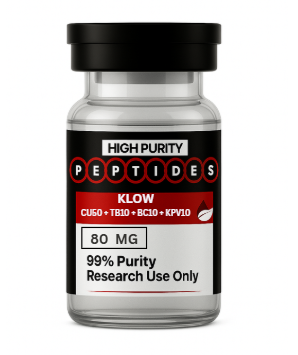
- KLOW 80mg 1 vial — review the listing for identity, format, and available batch documentation.
- KLOW STACK (CU50 + TB10 + BC10 + KPV10) 80mg × 10 vials — review the listing for identity, format, and available batch documentation.
How to evaluate research quality
A defensible KLOW Peptide Blend: Components and Research Overview evaluation begins with identity. The listing, material name, salt or counter-ion where relevant, quantity, lot number, and analytical record should agree. High-performance liquid chromatography can describe relative purity, while mass spectrometry can support identity by comparing observed and expected mass. Neither result alone proves biological activity, sterility, or fitness for this project’s protocol.
Study design and evidence limits
For KLOW Peptide Blend: Components and Research Overview experiments, define the hypothesis and primary endpoint before selecting a material. Preserve the model, controls, assay validation, acceptance criteria, and statistical plan. A pilot can justify a larger experiment, but it is not confirmation. In-vitro, animal, and controlled human research answer different questions, so results should not be transferred between evidence levels without justification.
Reproducibility notes
Reproducible KLOW Peptide Blend: Components and Research Overview work requires a documented chain of custody, calibrated equipment, validated assays, environmental records, and a log of protocol deviations. Findings are more useful when raw data and exclusion criteria are retained. This guide does not provide preparation, administration, or personal-use instructions.
Continue researching this topic
- Oxytocin Peptide Research: Measurement and Study Design related research overview
- Ipamorelin Online comparison and evidence guide
- Grey Market Peptides Explained laboratory quality discussion
Frequently asked questions
What should a laboratory verify before studying KLOW Peptide Blend: Components and Research Overview?
For KLOW Peptide Blend: Components and Research Overview, confirm identity, lot-specific analytical documentation, labeling, chain of custody, and alignment with the predefined protocol. Required tests depend on the planned study; a stated purity percentage is only one part of qualification.
Is this article personal-use or medical guidance?
No. It does not recommend use, administration, or dosing. Products discussed by High Purity Peptides are intended only for lawful laboratory research and are not for human or veterinary use.
Key takeaway
A credible KLOW Peptide Blend: Components and Research Overview project starts with a precise question, appropriate controls, traceable material, and cautious interpretation. Use analytical records and primary literature, preserve batch documentation, and report limitations alongside results.
Research-use notice: This content is for educational and laboratory-research purposes only. It is not medical advice. Research materials referenced here are not intended for human or veterinary use, diagnosis, treatment, or prevention of disease.