
The phrase High Purity Peptides BPC-157 usually reflects a branded search for product information, available research formats, and quality documentation. This guide explains how BPC-157 appears within the High Purity Peptides catalog and what a U.S. laboratory should verify before adding the material to a controlled research inventory.
What High Purity Peptides BPC-157 refers to
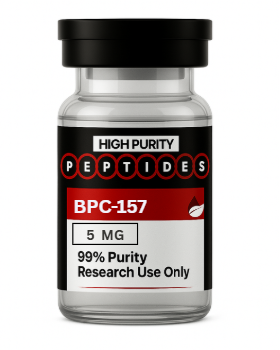
BPC-157 is a synthetic research peptide available as standalone vials and in clearly labeled multi-component formats. High Purity Peptides supplies these products for laboratory research, analytical evaluation, and method development only. A catalog listing is not medical advice and does not establish approval for personal, clinical, cosmetic, or veterinary use.
BPC-157 appears in standalone 5 mg and 10 mg vials, blends, capsules, and liquid research formats. These products should not share one generic record. Matrix, component count, labeled amount, lot, and supporting evidence may differ substantially between formats.
Research contexts associated with BPC-157
Depending on the approved project and available analytical methods, laboratories may examine BPC-157 in areas such as:
- sequence-specific analytical testing
- cellular and tissue-model research
- format and matrix comparisons
- standalone versus blend method development
These topics describe research directions, not promised outcomes. Experimental conclusions require suitable controls, validated methods, qualified interpretation, and documentation of the exact material used.
Available High Purity Peptides BPC-157 formats
The catalog includes 5 mg and 10 mg vials, BPC-157/TB-500 blends, capsules, and liquid research formats. Selecting a format should begin with the protocol: required total material, number of planned runs, controls, expected repeats, equipment capability, storage capacity, and matrix compatibility. Labeled strength is not a consumer dosage recommendation.
Relevant catalog options include BPC-157 5 mg research vials, BPC-157 10 mg research vials, BPC-157 and TB-500 capsule research format. Researchers can also review the complete research product catalog for current availability and specifications.
Review the product evidence
Confirm exact identity
The product name, sequence or defined chemical identity, expected molecular information, modification or complex where relevant, and labeled format should agree across the listing, label, specification, and COA. Similar naming is not proof that two products are interchangeable.
Connect the COA to the lot
A useful Certificate of Analysis identifies the tested sample, batch or lot, analytical method, test date, specification, and observed result. Confirm that the supplied material carries the same traceable identifier. A generic report should not be silently applied to a different batch.
Separate purity from identity
Chromatographic purity and molecular identity answer different questions. HPLC may support a relative purity result under defined conditions, while a suitable mass-based method may support identity. Review the peptide purity guide for more context.
Evaluate High Purity Peptides as the supplier
Before ordering, review the company information, ordering instructions, shipping information, and support page. A responsible purchasing decision considers documentation, labeling, fulfillment communication, and support—not only price.
For additional subject context, read BPC-157 research overview and BPC-157 cost and quality factors. Internal links should help a researcher move from general education to the exact product record without confusing informational content with clinical guidance.
Receiving and inventory checklist
- Compare the delivered name, format, strength, and quantity with the order.
- Inspect packaging, seals, container, and label condition.
- Record the supplier lot, receipt date, condition, and responsible person.
- Link the COA, invoice, product record, and internal inventory ID.
- Assign a documented storage location and record any excursion.
- Quarantine damaged, mismatched, or undocumented material pending review.
Once released, link each analytical run to the internal inventory identifier and supplier lot. Record transfers, remaining quantity, deviations, unexpected observations, and final disposition. These records make it easier to separate material questions from method, instrument, storage, and operator variables.
Frequently asked questions about High Purity Peptides BPC-157
Does the High Purity Peptides brand name prove BPC-157 quality?
No brand name replaces lot-specific evidence. Researchers should review the product specification, label, COA, identity information, purity result, and receiving record for the exact material purchased.
Does a larger vial or format mean higher purity?
No. Labeled quantity and purity are separate attributes. Choose quantity from project requirements and evaluate quality through appropriate documentation and testing.
Can online reviews verify a batch?
Reviews may describe ordering or support experiences, but they cannot establish molecular identity or purity for a specific lot. Use traceable analytical evidence and the laboratory’s acceptance procedure.
Final research purchasing decision
A defensible decision records why the exact BPC-157 format was selected, which evidence was reviewed, who approved it, and how the material will be received and controlled. This approach supports reproducibility while keeping the branded search firmly within a legitimate research context.
Before reporting results, verify that the product name, format, supplier, and lot cited in the study agree with the inventory and experimental records. Correcting this information early protects the accuracy of later comparisons.
Research-use notice
Research Use Only. Products discussed are intended solely for laboratory research, analytical testing, and method development. They are not intended for human or animal consumption, diagnosis, treatment, prevention, cosmetic use, or veterinary use. Statements have not been evaluated by the FDA.
