CJC-1295 No DAC is a topic in laboratory and preclinical research. This article examines the scientific context, how to assess the evidence, and which quality controls matter when U.S. laboratories evaluate research materials. It is educational content for qualified research settings—not dosing, treatment, or personal-use guidance. Researchers comparing materials can review the research peptide catalog and the site’s laboratory quality standards while qualifying a study material.
Research context and terminology
This subject should be evaluated by separating molecular mechanism, experimental model, measured endpoint, and evidence quality. That framework prevents preliminary findings from being presented as established conclusions.
CJC-1295 without DAC (commonly referred to as CJC-1295 No DAC ) is a synthetic growth hormone–releasing hormone (GHRH) analog developed for laboratory and experimental research use. Unlike its DAC-modified counterpart, the No DAC variant is designed to maintain a short biological half-life, making it particularly useful for studies focused on natural, pulsatile growth hormone (GH) secretion and endocrine signaling dynamics.
Because growth hormone physiology relies heavily on pulsatile release patterns, CJC-1295 No DAC has become an important research tool for investigators seeking to model endogenous hormone regulation more accurately in preclinical and experimental settings.
Understanding CJC-1295 and the Role of DAC Modification
CJC-1295 is a 30–amino-acid peptide that structurally mimics endogenous human GHRH. Its primary biological role is to stimulate GHRH receptors in the anterior pituitary, triggering the release of growth hormone. Once released, GH exerts downstream effects by stimulating insulin-like growth factor 1 (IGF-1) production, primarily in hepatic tissue, which then influences growth, metabolism, and tissue repair pathways.
The DAC (Drug Affinity Complex) modification is engineered to bind the peptide to circulating plasma proteins, significantly extending its half-life and duration of action. While this modification is advantageous for long-term GH elevation studies, it alters the natural rhythm of GH secretion.
In contrast, CJC-1295 No DAC lacks this affinity complex , resulting in rapid clearance from circulation. This shorter duration more closely resembles native GHRH activity and allows researchers to investigate physiological GH pulses without prolonged receptor stimulation.
Mechanism of Action of CJC-1295 No DAC
CJC-1295 No DAC exerts its effects by binding to GHRH receptors located on somatotroph cells in the anterior pituitary gland. Upon receptor activation, a signaling cascade is initiated that promotes the synthesis and release of growth hormone in discrete pulses rather than continuous secretion.
This pulsatile release pattern is essential for normal endocrine function, as it influences receptor sensitivity, downstream gene expression, and metabolic regulation. By preserving the short-acting nature of endogenous GHRH, CJC-1295 No DAC allows researchers to examine acute GH signaling events and their immediate physiological consequences.
Because the peptide does not remain active for extended periods, it minimizes prolonged GH exposure, which can otherwise complicate data interpretation in experimental models.
Research Applications of CJC-1295 No DAC
The pharmacokinetic profile of CJC-1295 No DAC makes it well suited for a variety of laboratory and preclinical research applications, including:
Growth hormone pulse dynamics , examining frequency, amplitude, and timing of GH release
IGF-1 regulation studies , focusing on tissue-specific responses to acute GH stimulation
Metabolic research , including glucose metabolism, lipid utilization, and energy balance in animal models
Regenerative and musculoskeletal research , where short-term GH signaling is evaluated in tissue repair and recovery models
Endocrine physiology studies , exploring feedback mechanisms and receptor sensitivity
Comparison Between CJC-1295 No DAC and CJC-1295 With DAC
While both variants share the same core peptide structure, their experimental applications differ significantly due to pharmacokinetic differences:
Half-life: No DAC has a short half-life, whereas DAC-modified CJC-1295 is long-acting
Administration frequency: No DAC requires more frequent administration in sustained studies
Physiological relevance: No DAC more closely replicates endogenous GH pulsatility
Research focus: No DAC is favored for acute and mechanistic studies; DAC variants are often used for chronic GH elevation models
Understanding these distinctions helps researchers select the appropriate peptide based on experimental objectives and study design.
Scientific and Laboratory Considerations
Analytical verification methods such as high-performance liquid chromatography (HPLC) and mass spectrometry are commonly employed to confirm peptide identity, purity, and batch consistency. These steps are critical for ensuring reproducibility across experiments.
Relevant research materials
- CD5 CJC‑1295 With DAC 5mg × 10 vials — review the listing for identity, format, and available batch documentation.
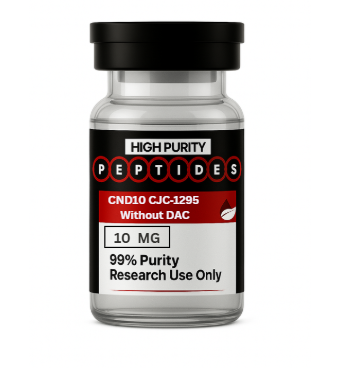
- CND10 CJC‑1295 Without DAC 10mg × 10 vials — review the listing for identity, format, and available batch documentation.
- CND5 CJC‑1295 Without DAC 5mg × 10 vials — review the listing for identity, format, and available batch documentation.
How to evaluate research quality
A defensible CJC-1295 No DAC evaluation begins with identity. The listing, material name, salt or counter-ion where relevant, quantity, lot number, and analytical record should agree. High-performance liquid chromatography can describe relative purity, while mass spectrometry can support identity by comparing observed and expected mass. Neither result alone proves biological activity, sterility, or fitness for this project’s protocol.
Study design and evidence limits
For CJC-1295 No DAC experiments, define the hypothesis and primary endpoint before selecting a material. Record the model, controls, assay validation, acceptance criteria, and statistical plan. A pilot can justify a larger experiment, but it is not confirmation. In-vitro, animal, and controlled human research answer different questions, so results should not be transferred between evidence levels without justification.
Continue researching this topic
- HGH Frag related research overview
- BPC-157—Research Applications, Mechanism, and Laboratory Considerations comparison and evidence guide
- AHK-Cu Peptide laboratory quality discussion
Frequently asked questions
What should a laboratory verify before studying CJC-1295 No DAC?
For CJC-1295 No DAC, confirm identity, lot-specific analytical documentation, labeling, chain of custody, and alignment with the predefined protocol. Required tests depend on the planned study; a stated purity percentage is only one part of qualification.
Is this article personal-use or medical guidance?
No. It does not recommend use, administration, or dosing. Products discussed by High Purity Peptides are intended only for lawful laboratory research and are not for human or veterinary use.
Key takeaway
A credible CJC-1295 No DAC project starts with a precise question, appropriate controls, traceable material, and cautious interpretation. Use analytical records and primary literature, preserve batch documentation, and report limitations alongside results.
Research-use notice: This content is for educational and laboratory-research purposes only. It is not medical advice. Research materials referenced here are not intended for human or veterinary use, diagnosis, treatment, or prevention of disease.