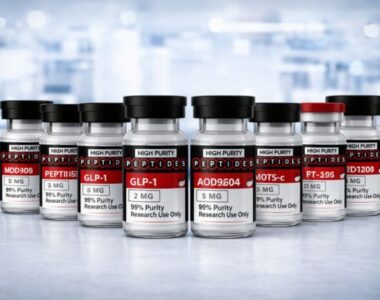
Bronchogen Peptide: Mechanisms, Biology & Research Insights is a topic in laboratory and preclinical research. This overview describes the scientific context, how to assess the evidence, and which quality controls matter when U.S. laboratories evaluate research materials. It is educational content for qualified research settings—not dosing, treatment, or personal-use guidance. Laboratories comparing materials can review the research peptide catalog and the site’s laboratory quality standards while qualifying a study material.
Research context and terminology
Short peptide bioregulators are marketed with broad claims, while the strength and accessibility of evidence vary widely. Researchers should prioritize primary literature, defined sequences, suitable controls, and reproducible endpoints.
Bronchogen peptide is a short bioactive peptide investigated in respiratory and pulmonary research for its potential influence on airway cells, inflammation signaling, and tissue homeostasis. While it is not a therapeutic or approved drug, Bronchogen represents a research tool for studying lung-specific cellular pathways and immune responses in laboratory and preclinical models. Its structure and mechanisms make it interesting for scientists exploring peptide-mediated signaling in pulmonary tissues.
Bronchogen is often considered within the broader category of tissue-specific bioregulator peptides, which are synthesized to reflect fragments of naturally occurring protein sequences. These fragments are believed to carry informational cues that modulate cell behavior and gene expression within a particular organ system—in this case, the bronchial and pulmonary environment.
Bronchogen peptide derives its name from “bronchial” and “gen,” indicating its association with lung and airway tissues. It is designed as a short amino acid sequence that resembles a biologically relevant region from a larger pulmonary protein. Researchers use Bronchogen in experimental settings to investigate how peptide fragments may influence lung cell signaling, epithelial integrity, and inflammatory processes.
Unlike hormones or growth factors that circulate systemically, Bronchogen does not act through classical endocrine pathways. Instead, it is hypothesized to interact with cellular receptors or intracellular signaling cascades that are particularly active in respiratory tissues.
Although the precise molecular targets of Bronchogen remain under investigation, researchers propose multiple mechanisms through which it may influence lung tissue biology:
Modulation of inflammatory signaling: Interacting with cytokine pathways to alter pro- and anti-inflammatory responses;
Support for epithelial integrity: Influencing cell adhesion, tight junctions, and barrier function in airway linings;
Cellular communication: Participating in local signaling that regulates cellular stress responses;
Immune modulation: Affecting how innate immune cells respond to respiratory stress or injury.
These proposed effects are grounded in laboratory and preclinical research that seeks to understand how short peptide fragments can influence tissue-specific pathways without systemic hormone-like effects.
Bronchogen peptide has been used in in vitro studies with lung epithelial cells, fibroblasts, and immune cells to assess its effects on cell signaling, gene expression, and cellular behavior under stress conditions. Researchers measure inflammatory cytokine profiles, cell survival pathways, and barrier integrity to determine how Bronchogen alters cellular responses.
Animal models may also be used to explore how Bronchogen affects respiratory tissues following injury or inflammatory challenge. Such studies help outline whether peptide-mediated modulation can improve recovery or alter pathological progression, although results remain highly specific to experimental conditions.
Comparison to Other Respiratory Peptides
Bronchogen is conceptually similar to other organ-associated peptides such as Cardiogen (cardiac) or Thymogen (thymus), which are designed to reflect fragments of larger, tissue-rich proteins. However, Bronchogen’s focus is on pulmonary tissue, and its experimental use centers on respiratory biology rather than systemic effects.
Unlike some peptides that influence systemic inflammatory or immune pathways, Bronchogen’s proposed mechanisms highlight localized modulation within lung tissue. This distinction makes it a useful research tool for investigators focusing on respiratory disease models and tissue-specific signaling.
Bronchogen peptide is intended strictly for research use. It has not been approved for clinical use or human therapy outside of approved experimental settings. Researchers working with Bronchogen must follow institutional guidelines for peptide handling, storage, and use in cell culture or animal models.
How to evaluate research quality
A rigorous Bronchogen Peptide: Mechanisms, Biology & Research Insights evaluation begins with identity. The listing, material name, salt or counter-ion where relevant, quantity, lot number, and analytical record should agree. High-performance liquid chromatography can describe relative purity, while mass spectrometry can support identity by comparing observed and expected mass. Neither result alone proves biological activity, sterility, or fitness for this project’s protocol.
Study design and evidence limits
For Bronchogen Peptide: Mechanisms, Biology & Research Insights experiments, define the hypothesis and primary endpoint before selecting a material. Preserve the model, controls, assay validation, acceptance criteria, and statistical plan. A pilot can justify a larger experiment, but it is not confirmation. In-vitro, animal, and controlled human research answer different questions, so results should not be transferred between evidence levels without justification.
Continue researching this topic
- NAD+ Peptides: Biology, Mechanisms & Research Overview related research overview
- AHK-Cu Peptide comparison and evidence guide
- Energy Peptides laboratory quality discussion
Frequently asked questions
What should a laboratory verify before studying Bronchogen Peptide: Mechanisms, Biology & Research Insights?
For Bronchogen Peptide: Mechanisms, Biology & Research Insights, confirm identity, lot-specific analytical documentation, labeling, chain of custody, and alignment with the predefined protocol. Required tests depend on the planned study; a stated purity percentage is only one part of qualification.
Is this article personal-use or medical guidance?
No. It does not recommend use, administration, or dosing. Products discussed by High Purity Peptides are intended only for lawful laboratory research and are not for human or veterinary use.
Key takeaway
A credible Bronchogen Peptide: Mechanisms, Biology & Research Insights project starts with a precise question, appropriate controls, traceable material, and cautious interpretation. Use analytical records and primary literature, preserve batch documentation, and report limitations alongside results.
Research-use notice: This content is for educational and laboratory-research purposes only. It is not medical advice. Research materials referenced here are not intended for human or veterinary use, diagnosis, treatment, or prevention of disease.